The Weaving Structure of the Matter Spectrum
Abstract
Under the sole structural input—the three-bit structure Z₂³—this paper gives the weaving structure of the matter spectrum. One elementary unit (denoted a_P) carries three bits and gives three mutually distinct readings: the bit sum gives the charge, Q = (bit sum)/3 ∈ {0, 1/3, 2/3, 1}; the bit position gives color, and the three basis vectors of ∧¹C³ are exactly the three colors red, green and blue—a single bit, only three colors, no “double color”; the exchange of bits gives the weak interaction (the permutation group S₃). The charge spectrum is 1×(0) + 3×(1/3) + 3×(2/3) + 1×1. One generation of charged fermions (including antiparticles) comprises 14: 6 quarks + 6 antiquarks + the electron + the positron. Each quark is expressed on the ring by one edge and is bound by gluons into a proton (a six-membered ring). Spin and statistics (spin 1/2 and spin 1) are observational input and are not derived here. The hydrogen molecule H₂ is assembled from two color-singlet proton rings and the electron covalent bond, with net charge 0.
1. Introduction
The Weaving Formula [1] defines the “weave” as a trivalent network W = (V, E, T) carrying group charges, and gives the quantum state |Ψ[W]⟩ of the network under the sole structural input G = Z₂³. The Weaving Origin of the Gauge Forces [2] derives from the same input the structure of the three gauge forces (the group, the number of colors, the number of gluons, and confinement).
The present paper carries that chain to matter: what one elementary unit reads out, who is on the spectrum, what charge and color they carry, how quarks and gluons coexist on the ring, and how two nucleons and two electrons assemble into the first molecule. The upstream derivation is not repeated here.
2. One Elementary Unit and Its Three Readings
The elementary unit of the weave is denoted a_P; it carries ℓ = 3 bits (G = Z₂³, 8 states in all). The three bits give three mutually distinct readings:
(1) The bit sum w = Σ_i b_i ∈ {0, 1, 2, 3} gives the charge
Q = w / ℓ = w / 3 ∈ {0, 1/3, 2/3, 1} (2.1)(2) The bit position gives color (§3).
(3) The exchange of bits gives the weak interaction (§5).
The charge spectrum corresponds layer by layer to the exterior algebra: ∧C³ = ∧⁰ ⊕ ∧¹ ⊕ ∧² ⊕ ∧³ (dimensions 1 + 3 + 3 + 1 = 8). By the sign rule [4], the four channels give four charge roles:
∧⁰ → 0 (neutral)
∧¹ → −1/3 (d-type)
∧² → +2/3 (u-type)
∧³ → −1 (electron-type)        (2.2)
Antiparticles take the conjugate (+1/3, −2/3, +1).
3. Color: Three Colors from a Single Bit
The carrier of color is ∧¹C³, whose dimension is the number of bits of a_P, ℓ = 3; hence the number of colors
N_c = ℓ = 3 (3.1)Color is expressed by a single bit only. The three basis vectors of ∧¹C³, 001, 010, 100 (one bit on at each of the three positions), are the three colors red, green and blue (no fixed correspondence):
color = a single bit: 001, 010, 100 (red, green, blue) (3.2)There are only three colors; there is no “double color”.
The gauge group is SU(ℓ) = SU(3), and the number of gluons is
N_c² − 1 = ℓ² − 1 = 8 (3.3)(Its two independent origins are given in [2] §5.)
4. Matter Content: One Generation = 14
Counting layer by layer along the charge channels (2.2): three in ∧¹ (d-type, Q = −1/3), three in ∧² (u-type, Q = +2/3), one in ∧³ (electron-type, Q = −1), and one in ∧⁰ (neutral, Q = 0). An elementary particle is expressed by one edge: quarks occupy ∧¹/∧², the electron occupies ∧³. The charged ones number 3 + 3 + 1 = 7; adding antiparticles (conjugate charge), one generation of charged fermions is
3×2 + 3×2 + 1×2 = 6 + 6 + 2 = 14 (4.1)that is, 6 quarks + 6 antiquarks + the electron + the positron (the observed spectrum of this generation is given in [3]).
Spin and statistics are observational input. The mechanism for spin 1/2 (fermions) and spin 1 (bosons) has no origin in existing theories (in the Standard Model spin is an input of the Lorentz-group representation and the statistics follow from the spin–statistics theorem, but there is no mechanism for “why this representation”). This paper does not derive statistics—the matter objects on the spectrum are taken to be fermions as observed.
The neutral channel (∧⁰, Q = 0) is a single one. If the observed neutrino is indeed a neutral fermion, then it corresponds to this channel—it is of a different origin from the charged fermions (it carries no charge), which is a structural explanation rather than a placement within the spectrum.
5. Three Readings Give Three Gauge Forces (Ref. [2])
The three readings of one and the same a_P give exactly the three gauge forces:
| Force | Reading | Structure | Bosons |
|---|---|---|---|
| U(1) | bit sum (charge) | phase field (the conjugate of charge) | photon ×1 |
| SU(2) | bit exchange | permutation group S₃ → double cover 2D₃ ⊂ SU(2) | W¹W²W³ ×3 |
| SU(3) | bit position (color) | endomorphisms of ∧C³ (u(ℓ) ⊕ su(ℓ)) | gluons ×8 |
- U(1): the phase degree of freedom of the charge Q; its long-wavelength limit is Maxwell's equations ([2] §3).
- SU(2): the permutation group S₃ of the bit positions, with the natural representation 3 = 2 ⊕ 1 (the two-dimensional component is the weak doublet); the breaking S₃ → S₂ gives the mass matrix diag(0, m², m²) ([2] §4).
- SU(3): color (∧¹C³); the number of gluons ℓ²−1 = 8 (§3).
Confinement is given by the single-bit-flip decomposition theorem: a charge-separated configuration cannot be decomposed into free string ends—quarks cannot be taken out singly ([2] §5.5).
6. Quarks and Gluons
A quark is expressed by one edge (its bit sum gives the charge); the color of the quark is expressed by the edge occupied by the gluon.
The atomic nucleus (the proton) falls in the diamond network into a closed six-membered ring, of length L = 2b_P = 6 a_P [5]: three edges are quarks (u, u, d) and the remaining three edges are occupied by gluons; the six edges alternate quark, gluon, quark, gluon, quark, gluon, and every vertex is a “quark bond–gluon bond” junction. The charges of the three quarks are +2/3, +2/3, −1/3, so the ring charge is +1; the three colors are one each, so the ring is a color singlet—namely the proton.
7. The Hydrogen Molecule H₂
H₂ is assembled from two proton rings and two electrons (Figure 1): the two rings share no a_P (nor any node), and each closes on itself. The electron is one edge (the ∧³ = 111 state: Q = −1, color singlet, hence colorless); the two electrons occupy one edge each, and the two electron edges emerge from nodes of the two proton rings and join each other, linking the two independent rings into a covalent bond—not the two rings sharing one edge. The total charge of H₂ is 2(+1) + 2(−1) = 0.
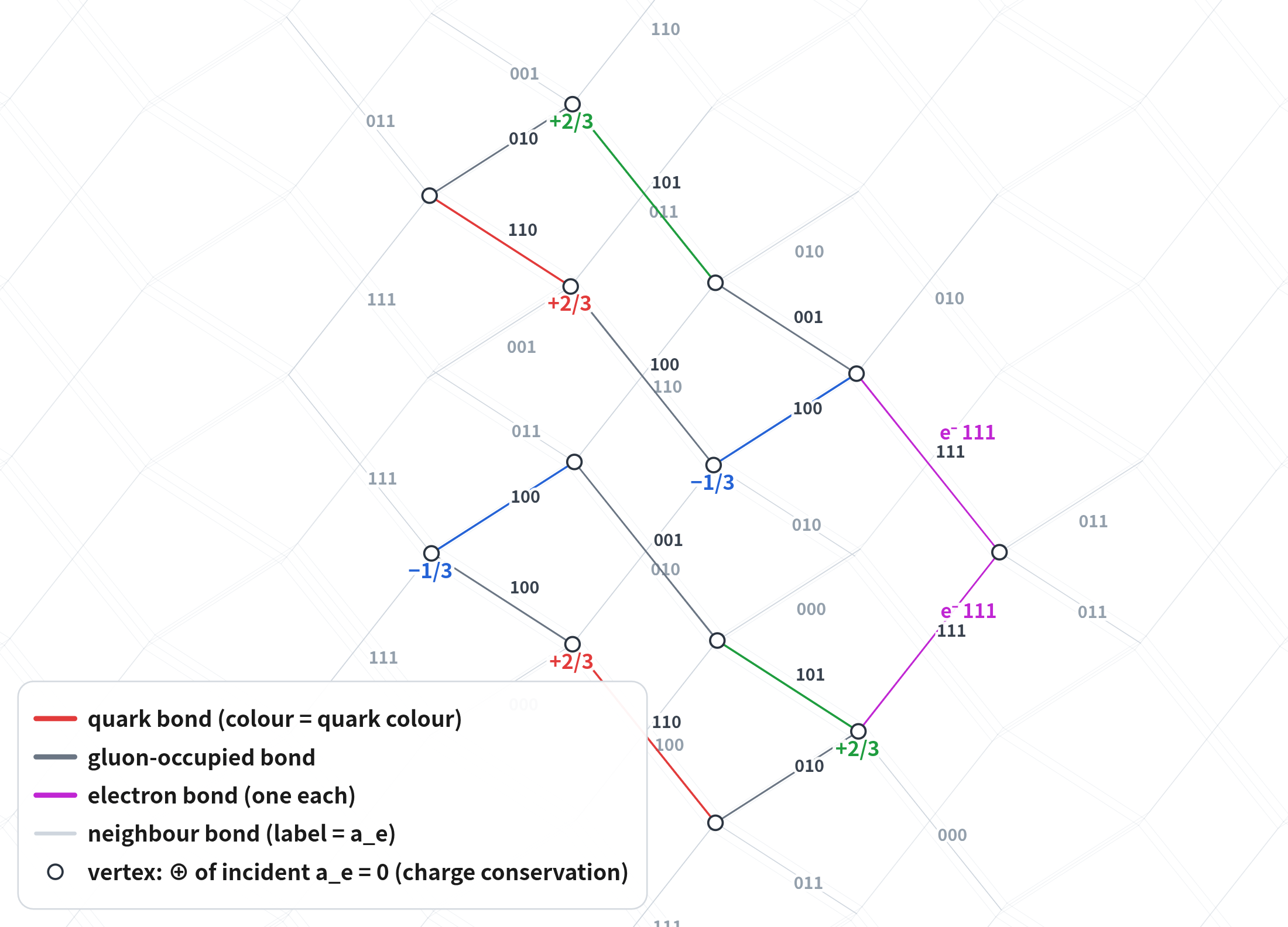
Figure 1. The weave assembly of the hydrogen molecule H₂: the two color-singlet proton rings (red, blue) have six edges each, three belonging to quarks and three occupied by gluons; the two electrons occupy one edge each, and the two electron edges link the two rings into a covalent bond. The net charge of the whole figure is 0.
As a possible corollary of the above picture: the position of the electron outside the atomic nucleus is not fixed—it is not a localized individual, but one occupied edge (an excitation, §4) of the weave network. The vacuum state also exists inside an atom: the occupied edges are only a minority, and the rest of the network remains in vacuum. The binding of the electron by the nucleus is provided by the gravitational (shared-metric) channel, which confines the excitation of the electron near the nucleus and makes it a persistent bound mode. Corollary 5 of the Weaving Formula ([1] §5.9) states that, under the charge-conservation constraint, a change in the charge of any one unit necessarily induces a synchronous change in the charges of the other edges at the same node, so that any cut through that constraint is necessarily entangled; the free quantum fluctuations subject to this constraint therefore correlate the excitation of the electron with the rest of the network, so that it is continually extinguished and re-illuminated elsewhere. What we observe is thus not the same electron individual, but the temporal continuity of the same excitation mode—“the same electron” should be read as the continuous mode carrying the same charge; the indistinguishability of electrons is precisely a direct consequence of the electron being a mode rather than an individual.
8. Numerical Verification
All conclusions are verified by exhaustive recomputation (the relevant values can be reproduced by designing computer simulation experiments as described in the text):
- One a_P = 3 bits = 8 states; the charge spectrum is layered by ∧ as 1 + 3 + 3 + 1.
- Color = three colors from a single bit (001, 010, 100); two bits are not a color.
- One generation of charged fermions = 3×2 + 3×2 + 1×2 = 14.
- Actual reading of the proton ring: the three quark edges are u, u, d (charges +2/3, +2/3, −1/3); the color of the quark is expressed by the edge occupied by the gluon; the ring charge is +1; a color singlet.
- Every vertex on the ring is a “quark bond–gluon bond” junction (the six edges alternate, with no same-kind adjacency).
- Changing the color of one bond ⇒ charge conservation is broken (one charge lands on each of the two vertices); only applying the same permutation to all bonds (a global color rotation) preserves conservation.
9. Boundaries and Conclusion
Boundaries (explicitly listed as open or as input):
- Spin and statistics are observational input: this paper does not derive the mechanism of spin 1/2 and spin 1—existing theories have no origin for it either.
- The generation structure: this paper gives one generation (14); multiple generations and their inter-generation structure are outside its scope.
- The dynamics of the string: the bit position as the color reading and string attachment as the origin of charge are used here only at the structural level; the dynamics of attachment, propagation and condensation are outside its scope.
Conclusion: one elementary unit of the three-bit structure Z₂³ reads out at once charge (the bit sum), color (the bit position, three colors from a single bit) and the weak interaction (bit exchange); one generation of charged fermions is 14; quarks and gluons each occupy one edge of the proton ring, the proton is a 6-edge ring, and two rings plus two electrons assemble into H₂.
References
[1] Liu Xinkuang, Ji Ya. The Weaving Formula: Emergence Mechanism of Spacetime Geometry[Z]. Zenodo. DOI: 10.5281/zenodo.22899821.
[2] Liu Xinkuang, Ji Ya. The Weaving Origin of the Gauge Forces[Z]. Zenodo. DOI: 10.5281/zenodo.22710656.
[3] S. Navas, et al. (Particle Data Group). Review of Particle Physics[J]. Physical Review D, 2024, 110(3): 030001. DOI: 10.1103/PhysRevD.110.030001.
[4] Liu Xinkuang, Ji Ya. The Weaving Origin of the Elementary Charge and the Gauge Couplings[Z]. Zenodo. DOI: 10.5281/zenodo.22726164.
[5] Liu Xinkuang, Ji Ya. The Weaving Origin of the Proton–Electron Mass Ratio: 1836[Z]. Zenodo. DOI: 10.5281/zenodo.22852481.
Citation
liu-xinkuang, ji-ya (2026). The Weaving Structure of the Matter Spectrum. https://doi.org/10.5281/zenodo.22928553