The Weaving Origin of the Proton–Electron Mass Ratio: 1836
Abstract
Starting from the Weaving Formula, and under the sole structural input—the color-flux saturation quantum number b_P = 3 (that is, the three-bit structure Z₂³, the same structural number that locks the color number)—this paper gives the leading term of the proton-to-electron mass ratio with zero free parameters. The geometric basis is the diamond net and its six-membered rings: the proton is one six-membered ring of the net (6 edges, 5 nonzero modes), and the ring-vibration identity gives the universal structural form m_p/m_e = 2b_P·π^(2b_P−1), b_P = 3 ⇒ 6π⁵ = 1836.118109 (a deviation from observation of −1.88×10⁻⁵, i.e. −0.0019%). The leading term contains no observational input and introduces no correction factor. One and the same b_P = 3 gives both the color number (N_c = 3) and the mass ratio (1836)—a structural number with two readings. The boundaries are explicit: the reading rule (2.3) is semiclassical; the residual of the leading term, −1.9×10⁻⁵, has no mechanistic explanation yet and is listed as an open question; the absolute value of mass (the conversion number from the ratio to an absolute mass) is likewise listed as open.
1. Introduction
1.1 The Problem: Ratios and Absolute Values Are Two Different Classes of Question
The Standard Model takes particle masses as free parameters: the origin of the electron mass and of the proton mass is not explained, and their ratio
m_p/m_e = 1836.15267343
(PDG [1]) can only be given by experiment. The existing theoretical constructions—from the constituent quark model to lattice QCD—can compute the proton mass, but all of them require a numerical solution for given couplings and given quark masses; the ratio itself is still not a number locked by structure.
The weave offers another entry. The weaving origin of the gauge structure was given in [2]; the weaving origin of the gauge strength and of the elementary charge e was given in [3]. This paper deals with a third class of quantity: the ratio of two masses. Its claim is that m_p/m_e is not a fitted number but a relation uniquely locked by the discrete structural numbers of the weave, with zero free parameters.
1.2 The Proposition of This Paper
The sole structural input of this paper is
b_P = 3,
i.e. the color-flux saturation quantum number takes the value 3 (locked by [2]: an edge carries ℓ = 3 bits, and the color carrier ∧¹C³ has dimension 3, hence the color number N_c = ℓ = 3). The geometric basis is the diamond net: it is a four-valent net whose shortest closed loop is the six-membered ring (6 edges), and projected along (111) it becomes a planar trivalent (honeycomb) net. With this input and this basis:
- the form of the two poles (see [4])—the electron is a point domain (one edge / 3 bits, ∧³ = 111, bit sum w = 3 ⇒ Q = 1; no internal vibration mode); the proton is a six-membered-ring domain (ring length L = 6 edges, three of its edges being quark edges and three occupied by gluons);
- the leading term—the ring-vibration identity gives m_p/m_e = 2b_P·π^(2b_P−1), b_P = 3 ⇒ 6π⁵ = 1836.118109, a deviation of −0.0019%; and b_P = 3 is the unique solution;
- the boundaries—the residual of the leading term, −1.9×10⁻⁵, has no mechanistic explanation yet; this paper introduces no correction factor and lists the residual as an open question.
1.3 Relation to Existing Work
This paper continues [2]: b_P = 3 (the color number) is a result of [2], and this paper finds that the same structural number simultaneously gives the mass ratio. The mechanistic picture agrees with string-net condensation [5]—mass (inertia) comes from the internal phase space of the domain, not from an externally imposed parameter; the way of reading is in line with the orientation “coupling / energy scale = state counting” of lattice gauge theory [6]. Methodologically the reading here is semiclassical (a phase space 2πJ per mode), of the same type as Bohr–Sommerfeld quantization [7–9].
The boundary between this paper and [2,3] is clear: [2] gives the gauge structure, [3] gives the gauge strength and e, and this paper gives the ratio of masses. The three share one and the same set of structural numbers (ℓ = 3, b_P = 3, 8 states per edge), and share no free parameter.
1.4 Structure of the Paper
The paper first reviews Weaving Theory and gives the geometric basis (the diamond net and the six-membered ring), then gives the weave form of the two poles (the point domain and the six-membered-ring domain), then gives the leading term 2b_P·π^(2b_P−1) and its uniqueness, then explains that it shares a structural origin with the color-number line, and finally states the boundaries and the open questions and gives the conclusions.
2. Weaving Theory and the Geometric Basis
2.1 The Weave and the Weaving Formula
The starting point of this paper is the Weaving Formula, whose definition and basic theorems are given in [10]. In brief, the weave is a charged network W = (V, E, T): V is the vertex set, E the edge set, and each edge carries a group charge a_e ∈ G (G a finite group); each vertex carries a tensor T_v : G^{∂v} → ℂ (legs correspond one-to-one with incident edges), subject to charge conservation (Tv ≠ 0 only if ⊕{e∈∂v} a_e = 0) and normalization. The Weaving Formula gives the quantum state of the network:
|Ψ[W]⟩ = Σ_{a ∈ G^E} ( Π_{v∈V} T_v(a|∂v) ) |a⟩ (2.1)that is, a sum over all edge-charge configurations whose amplitudes are products of vertex tensors. The gauge forces and the matter spectrum emerge from the collective behavior of this network.
2.2 The Geometric Basis: the Diamond Net and the Six-Membered Ring
The geometric basis of this paper is the four-valent realization of the weave—the diamond net: edge length a_P (the elementary unit; a_P = 2√ln8·l_P, defined in [10]), angles arccos(−1/3) = 109.4712°, 4 edges per vertex (given in pairs by the 8 states of an edge), and two face-centred cubic sublattices interpenetrating with a displacement of one quarter along the body diagonal (Figure 1). The shortest closed loop of this net is the six-membered ring: 6 edges, 6 vertices, all angles 109.4712°, in a chair form, the 6 vertices equidistant from the ring centre. Projected along the (111) direction, the diamond net becomes a planar trivalent (honeycomb) net; the six-membered rings then fall into two classes: a ring containing no edge along [111] projects to a regular hexagon (six equal projected sides, all interior angles 120°), whereas a ring containing such an edge projects to a rhombus (that edge projects to a point, and two vertices of the ring merge). This paper uses only this geometric fact: the ring length L = 6.
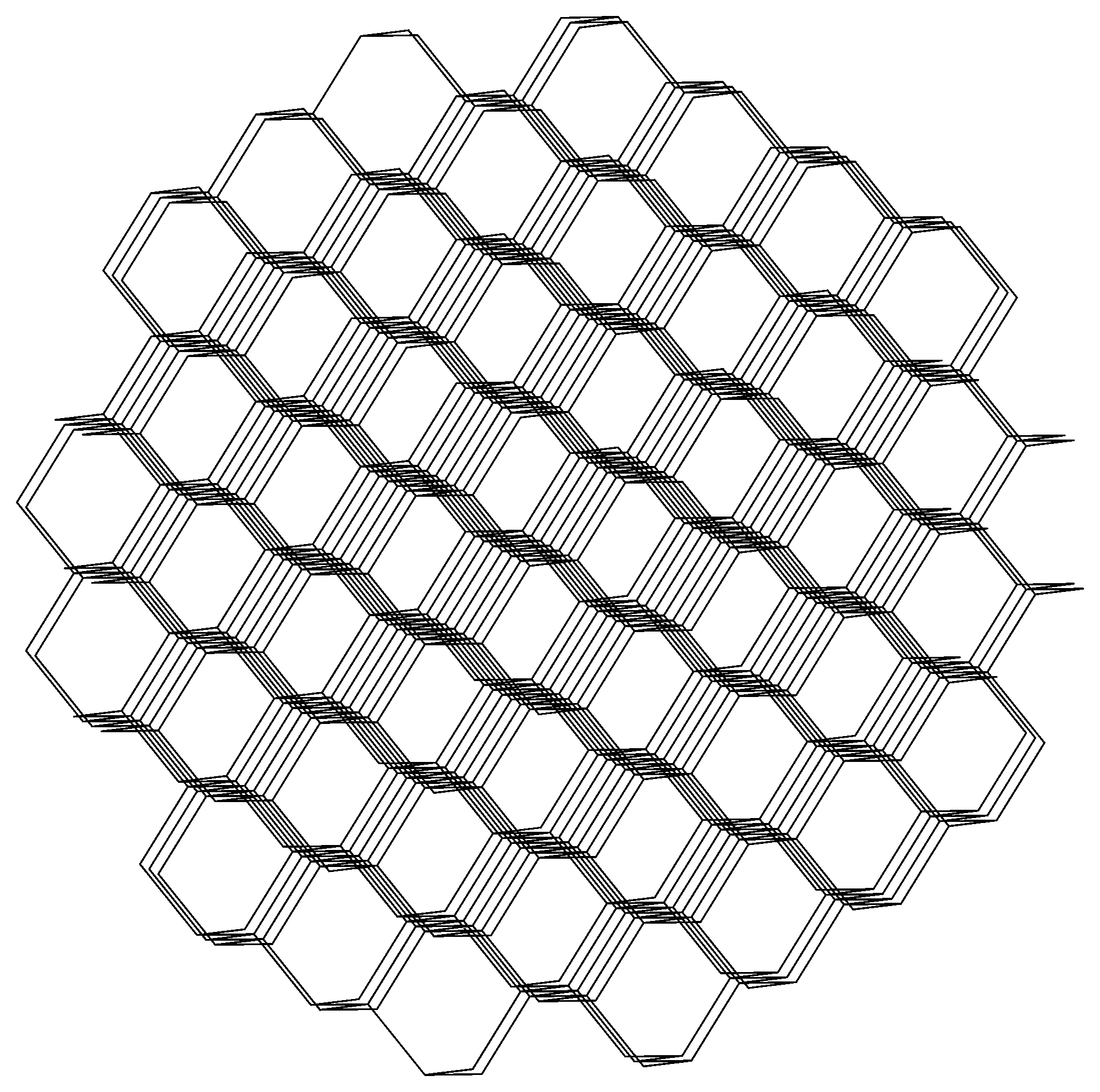
Figure 1. A three-dimensional diamond net cluster: the entire cluster is drawn (edges from boundary vertices pointing out of the net are omitted), edge length = a_P. Every interior vertex has 4 edges, pointing at the 4 vertices of a regular tetrahedron (angles arccos(−1/3) = 109.4712°); the shortest closed loop of the net is the six-membered ring (6 vertices, 6 edges). The 6 vertices of any six-membered ring are not coplanar (viewed along the body diagonal they undulate in a chair form); projected along (111), a six-membered ring containing no [111] edge becomes a regular hexagon, and one containing such an edge becomes a rhombus.
2.3 The Structural Input: b_P = 3
In [2], the state space of an edge is given by the exterior algebra: an edge carries ℓ = 3 bits, and the color is expressed by ∧¹C³, whose dimension is the color number (the gluon number being ℓ² − 1 = 8):
N_c = ℓ = 3, b_P = 3 (2.2)where b_P is the color-flux saturation quantum number—a discrete, rigid, dimensionless structural number on the weave side, with no room for continuous adjustment. The whole analysis of this paper uses this single number.
2.4 The Ring-Point Criterion: Mass ∝ Internal Phase Space
This paper adopts the mass reading rule of the weave (the Layer-4 reading; for its strict form see §6.2 item 1):
m(particle) ∝ ∏_n (2π J_n) (the internal phase space of that domain) (2.3)where the product runs over the internal nonzero modes of the domain and J_n = sin(πn/L) = ω_n/2 is the mode amplitude of the n-th mode (§3.3). Physical reading: inertia (mass) = the internal phase space of the domain—each mode contributes “the phase of one circuit around the ring, 2π” × “the mode amplitude J_n”, i.e. the per-mode factor 2πJ_n = πω_n (the two forms are equivalent). Hence the power of π = the number of modes, and π comes from the topological closure of the ring and contains no unit-system constant.
The reading takes a product rather than a sum: a sum (of the Bose zero-point-energy type, Σ_n ω_n = 7.464) has no power of π and disagrees with 1836; the product corresponds to the fermion determinant (det = ∏λ_n), consistent with the fermionic type of mode of Weaving Theory. One further choice is whether the per-mode phase 2π enters the “volume”: taking the volume (keeping 2π) gives 6π⁵; taking the state count (N = phase space/(2πℏ)^n, where 2π normalizes away) gives ∏_n J_n = 3/16 < 1, in contradiction with observation. This paper takes the volume, on the grounds of the geometric reading “one circuit around the ring per mode = 2π” [7–9], of the same type as the product-form partition function Z = ∏_n Z_n [11]; this normalization choice is discussed in §6.2 item 1.
Note: the per-mode factor 2πJ_n is a purely geometric quantity (it contains no ℏ), so both phase spaces are pure numbers and the ratio is independent of the system of units; a difference in mode number changes only the power of π. By (2.3), the mass ratio reduces to a ratio of modes—this is the skeleton of this paper.
3. The Weave Form of the Two Poles
3.1 The Electron: a Point Domain (0 Modes)
The identity of the electron in the weave is a point domain—a localized defect that carries no internal structure closing a color loop. In the weave an elementary particle is expressed by one edge (3 bits) (see [4]): the bit sum gives the charge, and the bit positions give the color. The electron is the simplest of them: all three bits are occupied (∧³ = 111, bit sum w = 3 ⇒ Q = 1). Spin and statistics are taken as observational inputs and are not derived here. Its charge and its number of internal modes are
Q_e = 1 (w = 3, Q = w/ℓ = 1), number of internal nonzero modes = 0 (3.1)A point domain has no internal vibrational degrees of freedom, so its internal phase space is 1: m_e ∝ 1.
3.2 The Proton: a Six-Membered-Ring Domain (Ring Length 6)
The proton is one six-membered ring of the diamond net—a color-singlet ring whose six edges comprise three quark edges and three occupied by gluons in alternation (see [4]; §2.2), of ring length
L = 2b_P = 6 (3.2)The ring length follows directly from the geometry: a six-membered ring has 6 edges, and 6 = 2b_P; at the same time ∏_n ω_n = 6 (§3.3) and the order of the permutation group |S₃| = 6 give the same number. The vibration modes of the ring are determined by its length: a ring of length L has L − 1 = 5 nonzero modes (the center-of-mass (translational) mode is excluded, since it corresponds to an overall displacement rather than to an internal degree of freedom).
3.3 The Mode Spectrum of the Ring
The vibration modes of the six-membered ring are given by the discrete Laplacian spectrum of C₆: at unit edge stiffness the eigenvalues are λ_n = 4 sin²(πn/6) = 1, 3, 4, 3, 1 (an integer spectrum), so the mode frequencies (discarding the n = 0 center-of-mass mode) are
ω_n = 2 sin(πn/L) = 2 sin(πn/6), n = 1, …, 5 (3.3)i.e. ω_n = 1, √3, 2, √3, 1 (n = 0 is the center-of-mass mode and is not counted as intrinsic mass). Writing the mode amplitudes as J_n = sin(πn/L) = ω_n/2, their product gives two purely geometric numbers (independent of observation):
∏_{n=1}^{5} J_n = 3/16, ∏_{n=1}^{5} 2 J_n = ∏_{n=1}^{5} ω_n = 6.
∏_{n=1}^{m−1} ω_n = m is a root-of-unity identity (Appendix A) and gives 6 at L = 6—that is, the number of vertices of the ring, which in the three-bit structure also equals the order of the permutation group |S₃|. Both 6 and 3/16 are numbers fixed by the ring geometry, not conventions. The phase space per mode is taken as 2πJ_n = πω_n (phase of one circuit around the ring × amplitude); the two forms are equivalent (§2.4).
4. The Leading Term: 2b_P·π^(2b_P−1)
4.1 The Ring-Vibration Identity
The leading term of this paper rests on a classical product identity (proof and numerical verification in Appendix A):
∏_{n=1}^{m−1} 2π sin(πn/m) = m·π^(m−1) (4.1)Substituting the ring length m = L = 2b_P gives the leading term:
m_p/m_e = ∏_{n=1}^{2b_P−1} 2π sin(πn/2b_P) = 2b_P·π^(2b_P−1) (4.2)(4.2) is the structural form: it holds for arbitrary b_P (universal), and the power of π is locked automatically by the identity; the concrete value depends on the assumption b_P = 3.
4.2 The Phase-Space Reading Mechanism
The physical reading of (4.2) is (2.3):
- the proton (a ring, 5 modes)—each mode contributes 2πJn, so the phase space is `∏{n=1}^{5}(2πJn) = (2π)⁵·∏{n=1}^{5} sin(πn/6) = 6π⁵`;
- the electron (a point, 0 modes)—the phase space is 1 (empty product).
Hence m_p/m_e = 6π⁵/1 = 6π⁵. That is,
m_p/m_e = (internal phase space of the ring domain) ÷ (internal phase space of the point domain).
Note that this is a ratio of dimensionless phase-space volumes; reading it as a mass ratio relies on the reading rule of §2.4 (its strict form is in §6.2 item 1).
4.3 Uniqueness
Table 1. Ring-length scan: only b_P = 3 falls on 1836
| b_P | ring length 2b_P | number of modes 2b_P−1 | value | deviation |
|---|---|---|---|---|
| 2 | 4 | 3 | 124.025107 | −93.245% |
| 3 | 6 | 5 | 1836.118109 | −0.0019% |
| 4 | 8 | 7 | 24162.345822 | +1215.92% |
Only b_P = 3 gives 1836. This uniqueness presupposes the ring length of §3.2 (the 6 edges of the six-membered ring, L = 6); under that presupposition, b_P = 3 is locked by the color number of [2] and is an algebraic necessity, not a pick from a pile of candidates. A ring-length scan (m = 2, …, 8) gives 6.283, 29.609, 124.025, 487.045, 1836.118, 6729.724, 24162.346—only m = 6 falls on 1836.
4.4 The Value of the Leading Term and the Residual
6π⁵ = 1836.118109 (4.3)observation 1836.15267343, relative residual δ_obs ≡ (leading term − observation)/observation = −1.8825×10⁻⁵ (−0.0019%) (4.4)The leading term contains no observational input and introduces no correction factor: the residual −1.8825×10⁻⁵ currently has no mechanistic explanation and is listed as an open question (§6.2, §6.3).
5. A Common Structural Origin: One and the Same b_P
The common structural origin of the two lines is a fact that holds already: b_P = 3 (this paper, the mass ratio) and ℓ = 3, b_P = 3 ([2], the color number and the gauge structure) come from one and the same set of structural numbers, with zero free parameters throughout. One and the same discrete structural number locks both the color number N_c = 3 and the mass ratio 1836—this is the strongest structural conclusion of this line.
6. Discussion and Boundaries
6.1 The Quantities of This Paper Are A-Layer Pure Numbers
The layering is by whether a dimension is carried: the A layer = pure numbers / ratios (given directly by the weave, needing no ruler), the B layer = absolute values with dimension (needing a ruler, namely the lattice spacing). m_p/m_e is an A-layer quantity—the derivation of this paper uses only discrete mode counting and π, and contains no observational input. This is the key difference from absolute masses (B layer): the latter need a ruler, the former do not. The ruler is given by the weave: the unique length scale a_P fixes the unique mass unit m₀ = ħ/(a_P c) (a_P = 2√ln8·l_P). Hence the remaining problem for B-layer quantities is not “units” but the value of that conversion number (the reciprocal of the mass fraction number, m₀/m) (§6.3 item 4).
6.2 Honest Boundaries
- the strict form of the reading rule—(2.3) adopts the reading rule of the weave (Layer 4): the per-mode factor 2πJ_n = 2π sin(πn/L) (phase of one circuit around the ring × standing-wave amplitude), and the product is taken rather than the sum (the Layer-3 ruling, corresponding to the fermion determinant); the power of π = the number of modes is given by the topological closure of the ring. What remains to be refined is: taking λ_n as an operator definition of mass = det(domain mode operator) (which needs the domain Hamiltonian), and the normalization choice between phase-space volume and state count (§2.4; the two differ only by the per-mode normalization 2π and are different quantities from the conversion number of §6.3 item 4—they must not be confused);
- the residual of the leading term has no mechanistic explanation—the origin of −1.8825×10⁻⁵ is unknown; this paper introduces no correction factor and lists it as an open question (§6.3). The residual does not affect the status of the leading term with zero free parameters;
- the origin of b_P = 3 is the citation of [2]—this paper does not repeat its derivation; if the locking of b_P in [2] is revised, this paper is revised accordingly.
6.3 Open Questions
Table 2. List of open questions
| # | question | layer (A/B) | mechanism |
|---|---|---|---|
| 1 | a strict derivation of mass = internal phase-space volume from the weaving action (including the volume-vs-state-count choice) | A layer | structural layer |
| 2 | the origin of the residual of the leading term, −1.8825×10⁻⁵ (a structural correction, or a numerical coincidence) | A layer | ? |
| 3 | the precise value of α (the e line, [3])—its precision of comparison with the leading term of this line | A layer | one-loop layer |
| 4 | the value of the conversion number from the ratio to an absolute mass (the reciprocal of the mass fraction number, m₀/m): for the electron m₀/m_e ≈ 8.3×10²¹ | B layer | structural layer |
Clues for item 4 (none adopted): v/m_e has a unique numerical match below 0.5%, 160π⁷ = 483246.9 (observation 481839.8, deviation +0.292%), where 5 = number of modes and 7 = number of nonzero g are both structural numbers of the weave; but the mechanism for 2⁵ and π⁷ is not established, and a numerical match ≠ a mechanism, so it is not taken as a result and is recorded only as a clue:
v/m_e ≟ 160π⁷ (+0.292%, weak structural grounds, not adopted) (6.1)6.4 Originality
Starting from an edge and going all the way to e (1/α(M_Z) = 13π², off by 0.28%), to m_p/m_e (a leading term with zero free parameters, deviating by −0.0019%), and to the accompanying electroweak structure—no one has done this before. In the history of science there are many precedents for “structure + number + zero parameters” being established first and the rigorous derivation following later (the Bohr model is one [7]); the position of this paper is the former: the conclusions are locked by the discrete structural numbers of the weave, and it can be wrong (§6.2 lists all known weak points, §6.3 lists the open questions).
7. Conclusions
- m_p/m_e = 2b_P·π^(2b_P−1) (b_P = 3 ⇒ 6π⁵ = 1836.118109)—entirely determined by the structural constants of the weave, with zero free parameters and a deviation of −0.0019%; on the basis of the diamond net / six-membered ring, the ring length, the number of modes, and the phase-space product are all geometric quantities;
- the color number and the mass ratio share a common origin—one and the same b_P = 3 gives both N_c = 3 and 1836, the strongest structural conclusion of this line;
- the reading rule of the leading term (semiclassical) remains to be made strict; the residual −1.9×10⁻⁵ has no mechanistic explanation yet, and this paper introduces no correction factor; the remaining problem of the absolute value of mass—the conversion number from the ratio to an absolute mass—is left open (§6.2, §6.3).
References
[1] S. Navas, et al. (Particle Data Group). Review of Particle Physics[J]. Physical Review D, 2024, 110(3): 030001. DOI: 10.1103/PhysRevD.110.030001.
[2] Liu Xinkuang, Ji Ya. The Weaving Origin of the Gauge Forces[Z]. Zenodo. DOI: 10.5281/zenodo.22710656.
[3] Liu Xinkuang, Ji Ya. The Weaving Origin of the Elementary Charge and the Gauge Couplings[Z]. Zenodo. DOI: 10.5281/zenodo.22726164.
[4] Liu Xinkuang, Ji Ya. The Weaving Structure of the Matter Spectrum[Z]. Zenodo. DOI: 10.5281/zenodo.22928553.
[5] Xiao-Gang Wen. Quantum orders and symmetric spin liquids[J]. Physical Review B, 2002, 65(16): 165113. DOI: 10.1103/PhysRevB.65.165113.
[6] John B. Kogut. An introduction to lattice gauge theory and spin systems[J]. Reviews of Modern Physics, 1979, 51(4): 659–713. DOI: 10.1103/RevModPhys.51.659.
[7] Niels Bohr. On the constitution of atoms and molecules[J]. Philosophical Magazine, 1913, 26(151): 1–25. DOI: 10.1080/14786441308634955.
[8] Albert Einstein. Zum Quantensatz von Sommerfeld und Epstein[J]. Verhandlungen der Deutschen Physikalischen Gesellschaft, 1917, 19: 82–92.
[9] Lev D. Landau, Evgeny M. Lifshitz. Quantum Mechanics: Non-Relativistic Theory[M]. 3rd ed. Oxford: Pergamon Press, 1977.
[10] Liu Xinkuang, Ji Ya. The Weaving Formula: Emergence Mechanism of Spacetime Geometry[Z]. Zenodo. DOI: 10.5281/zenodo.22899821.
[11] Richard P. Feynman. Statistical Mechanics: A Set of Lectures[M]. Reading: W. A. Benjamin, 1972.
Appendix
Appendix A. Proof and Numerical Verification of the Ring-Vibration Identity
Lemma: for any integer m ≥ 2,
∏_{n=1}^{m−1} 2 sin(πn/m) = m (A.1)Proof: from z^m − 1 = (z − 1)·∏_{n=1}^{m−1} (z − e^{2πin/m}), cancelling (z − 1) on both sides gives
z^(m−1) + z^(m−2) + … + z + 1 = ∏_{n=1}^{m−1} (z − e^{2πin/m}).
Setting z = 1, the left-hand side is m; taking the modulus of the right-hand side gives ∏_{n=1}^{m−1} |1 − e^{2πin/m}| = ∏_{n=1}^{m−1} 2 sin(πn/m) (using |1 − e^{iθ}| = 2 sin(θ/2), θ = 2πn/m). Hence ∏ 2 sin(πn/m) = m. ∎
From (A.1) the form used in this paper follows immediately:
∏_{n=1}^{m−1} 2π sin(πn/m) = (2π)^{m−1} · m / 2^{m−1} = m·π^(m−1) (A.2)Numerical verification (m = 2, …, 8; the left-hand side compared with m π^(m−1) term by term):
Table A.1. Numerical verification of the ring-vibration identity (A.2)
| m | ∏ 2π sin(πn/m) | m·π^(m−1) | relative difference |
|---|---|---|---|
| 2 | 6.283185 | 6.283185 | 0 |
| 3 | 29.608813 | 29.608813 | ~10⁻¹⁶ |
| 4 | 124.025107 | 124.025107 | ~10⁻¹⁶ |
| 5 | 487.045455 | 487.045455 | ~10⁻¹⁶ |
| 6 | 1836.118109 | 1836.118109 | ~10⁻¹⁶ |
| 7 | 6729.724355 | 6729.724355 | ~10⁻¹⁶ |
| 8 | 24162.345822 | 24162.345822 | ~10⁻¹⁶ |
In the geometry of this paper, m = L = 6 is the number of edges of the six-membered ring (§2.2); the discrete Laplacian spectrum of C₆ is λ_n = 4 sin²(πn/6) = 1, 3, 4, 3, 1 (an integer spectrum), so the frequencies of the 5 nonzero modes are exactly ω_n = 1, √3, 2, √3, 1.
Appendix B. Power-Law Scan and Uniqueness
Scanning single combinations of the structural numbers of the weave (3, 5, 6, 7, 8, 12, 16, etc.) with powers of π, among the matches with a deviation below 2%, 2b_P·π^(2b_P−1) is so far the only one that has both a mechanism and a closed loop in b_P (this is a statement about the candidate space, not a theorem); the b_P scan (2 / 3 / 4) is in §4.3—only b_P = 3 falls near 1836. The relevant numbers can be reproduced independently as described in the text.
Appendix C. Table of Numbers
Table C.1. All structural numbers and values
| quantity | structural form | value (b_P = 3) |
|---|---|---|
| ring length | 2b_P | 6 |
| number of modes | 2b_P − 1 | 5 |
| mode-amplitude factor | ∏ 2J_n = ∏ 2 sin(πn/2b_P) | 6 = |S₃| |
| leading-term ratio | 2b_P·π^(2b_P−1) | 6π⁵ = 1836.118109 |
| observed ratio | — | 1836.15267343 |
| residual of the leading term | (leading term − observation)/observation | −1.8825×10⁻⁵ (−0.0019%, unexplained) |
Citation
liu-xinkuang, ji-ya (2026). The Weaving Origin of the Proton–Electron Mass Ratio: 1836. https://doi.org/10.5281/zenodo.22951070